
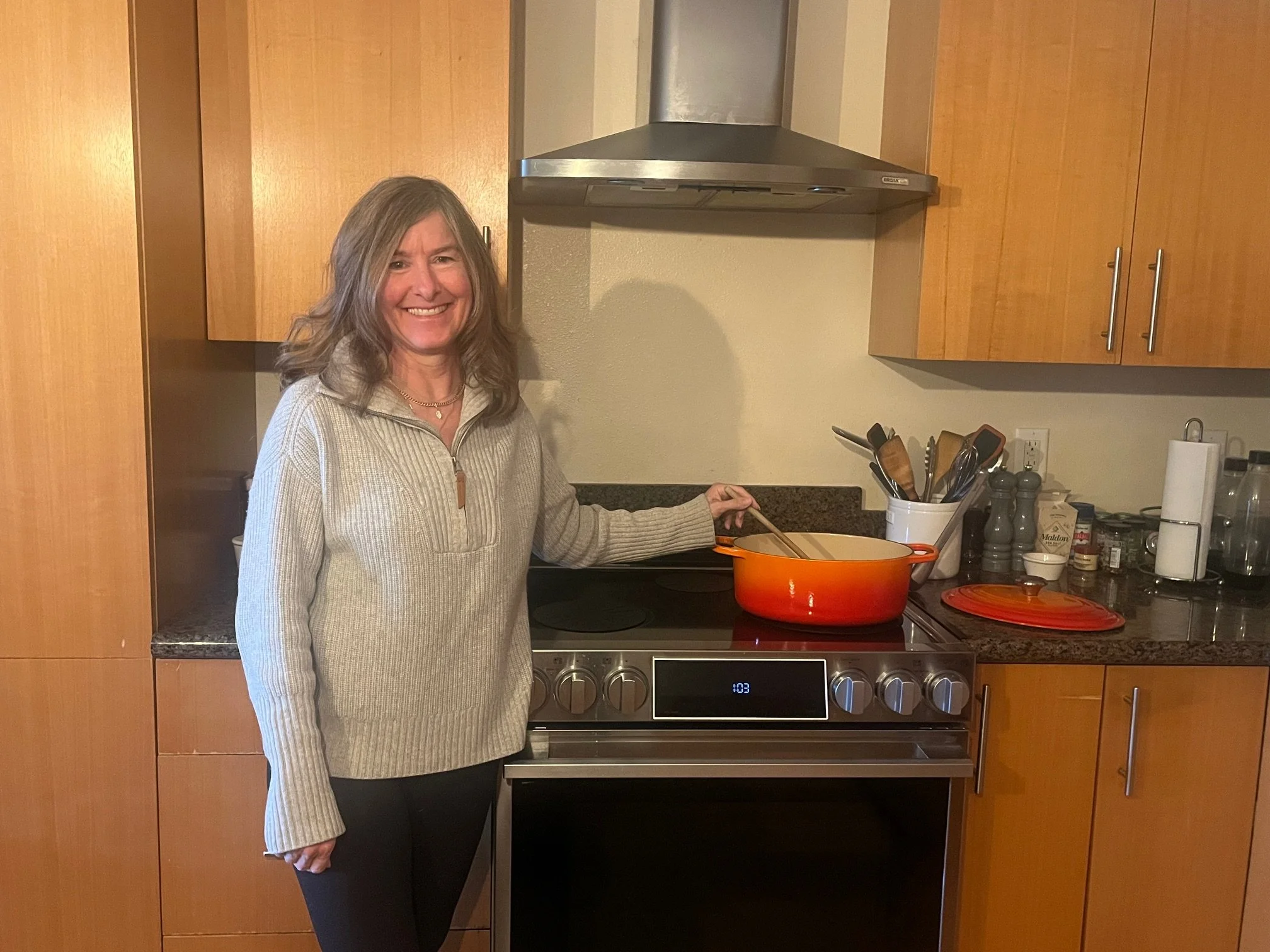
Earlier this year, this Oregonian stopped cooking with gas. She hasn’t looked back.
Elicia Putnam, the co-Executive Director of Electrify Oregon, cooks it all: she sears steaks, simmers soups, and flash fries noodles. Her regular rotation includes thai curries, huevos rancheros, and turkey chili. And these days, she does it all on an induction stovetop.
Induction stoves run on electricity, but they work differently from traditional electric stovetops. Rather than heating cookware through a burner, induction stoves use an electromagnet to generate a current directly inside your pots and pans. Your cookware heats up, but the stove itself remains cool.
There’s a common misconception that gas burns hotter and cooks more effectively than electricity. But Elicia and the roughly four million other households that have made the switch to induction cooking tend to disagree. “It is by far the best cooking option I have ever experienced,” Elicia says. She has found that her induction stove heats pans faster and with higher precision than gas — all while being safer, more energy efficient, and better for indoor air quality.
Here’s everything there is to love about induction cooking from a seasoned home chef, plus tips for getting started.
Why ditch gas?
Until eight months ago, Elicia had little experience with induction cooking. But as the time came to replace the aging gas stove in her Portland condominium, she knew it was time to make the switch. For one, gas stoves are a significant source of exposure to nitrogen dioxideand benzene — air pollutants associated with increased risk of respiratory illness, chronic lung conditions, and certain cancers.
Gas stove pollution doesn’t just have an effect on human health — it also affects the health of the planet. The natural gas that powers stoves is actually methane, a climate pollutant that traps 20 times as much heat as carbon dioxide. Methane leaks out at every step of the journey that it takes to our homes: from oil fields, to pipelines, to the kitchen. Even when our stoves aren’t in use, they leak this powerful gas. “Gas stoves are no joke,” Elicia said.
Elicia and her husband were already phasing gas out of their lives in other ways: switching from a gas-powered car to an electric one, from a gas furnace to an ultra-efficient heat pump. An induction stove was the natural next step.
A kitchen upgrade
Elicia quickly learned that induction cooking wasn’t just the smarter choice for her health and the planet. It leveled up her cooking as well. Because induction stoves heat cookware directly, rather than through a burner, they work more efficiently. Water boils in under a minute. Oil heats up almost immediately.
Temperature control and heat distribution also got easier with induction compared to gas. “It’s really easy to precisely regulate heat for things like rice. You can set it right where it needs to be, and it’s a very even distribution of heat,” Elicia says.
And owning an induction stove cleared up a common misconception that even Elicia believed until recently — that these stoves just don’t get hot like gas does. “It’s just not true at all,” Elicia says. Elicia’s stove sears crispy chicken thighs and flash fries asian dishes better than many of the gas stoves she has owned.
There is a learning curve to induction, Elicia says. “The biggest thing was just how quickly things get hot,” she says. She no longer waits for oil to get hot. Occasionally, when following a recipe, she has to cut suggested cooking times in half.
Getting started
Making the switch to induction was easier — and less expensive — than Elicia expected. She and her husband opted for an LG Studio slide-in induction range. (The exact model has been discontinued, but similar ranges retail for less than $1,500.) Because the stove requires a 220V plug, they needed to hire an electrician to switch out their old 120V outlet, which cost another $600. Initially, Elicia was daunted by the electric work, but she didn’t need to be. “It wasn’t nearly as difficult as we thought it was going to be,” she says.
Another switch Elicia had to consider was her cookware: induction stoves only work with pots and pans that have a magnetic base, such as cast iron, enameled cast iron, or magnetic stainless steel. Fortunately, she already had a collection of cast iron pans and enameled dutch ovens that worked just fine.
Getting rid of the old stove, too, turned out to be simpler than expected. Lowes, where Elicia and her husband purchased their range, disposes of old appliances for free alongside the delivery of a new appliance.
We’re here to help
Want to reduce your own exposure to indoor air pollution and move away from gas? Curious about making the switch to induction cooking? Meet with an electrification coach for free! They’ll help you discuss options, explore incentives, and make a plan.