
Electric vehicles keep getting better.
On the fence about EV ownership? Read on.
When Sharon Dohrmann purchased her first electric vehicle in 2016, she knew she was making the right decision for the climate, but she was nervous about how the car would fit into her life.
When Sharon purchased her EV, she had bought it to commute to her new job in Medford — 25 minutes from where she lived in Ashland. But she was worried that the range wouldn’t reliably get her where she needed to go. “At the time, the battery life on cars wasn’t what it is today,” Sharon said. “I was kind of freaked out.”
Sharon, the Board President of Ashland Climate Collaborative, ended up finding a deal on a used Nissan Leaf, which got 90 miles on a full charge.
Even despite the Leaf’s low range, It turned out that Sharon’s anxiety was unnecessary. “Once I realized how little I was driving each day — 15, 20 miles at most, I realized it was going to work fine,” Sharon says. “It was perfect.”
Electric vehicles have come a long way in the past decade. Some models get four or five times the range of Sharon’s Leaf. (She has since swapped that car for a newer EV — but more on that later.) With a much wider variety of options, drivers will have an easier time finding a model that fits their lifestyle and driving habits.
If you’re trying to decide whether to spring for an EV, here’s what to consider.
Managing range anxiety
Many would-be buyers are deterred by the perception that an EV won’t take them as far as a gas powered car. While it’s true that EVs do have some limitations, as far as range goes, technology and charging infrastructure have improved to the point that these vehicles are more than adequate for the average driver’s commute, errands, and road trips.
“Range anxiety is a real thing,” says Alan Bates, an electric transportation specialist for Portland General Electric and board member for Lake Oswego Sustainability Network. “What I have found is that after two or three weeks of driving, that range anxiety goes from a ten out of ten to a one or two.”
That’s in part because many people, like Sharon, have the perception that they drive more than they do. According to a Consumer Affairs survey, the average American drives just 37 miles per day, primarily for errands and commuting to work. And only 2% of those trips are longer than 50 miles. In comparison, the EVs with the longest ranges on the market drive upwards of 450 miles on a full charge. Even budget EVs, like the Chevy Bolt, get more than 250 miles — plenty for an in town trip and increasingly practical for the occasional longer road trip.
Some considerations: real-world battery range can depend on a number of factors. Cold weather, for instance, can reduce range. So can driving uphill. (But driving downhill can actually add miles!) And you won’t max out your range will every single charge — each subsequent charge on a road trip gets fewer miles. “As you drive and the battery heats up, it doesn’t recharge to that full amount again until the car cools down,” Sharon says.
Taking an all-electric road trip
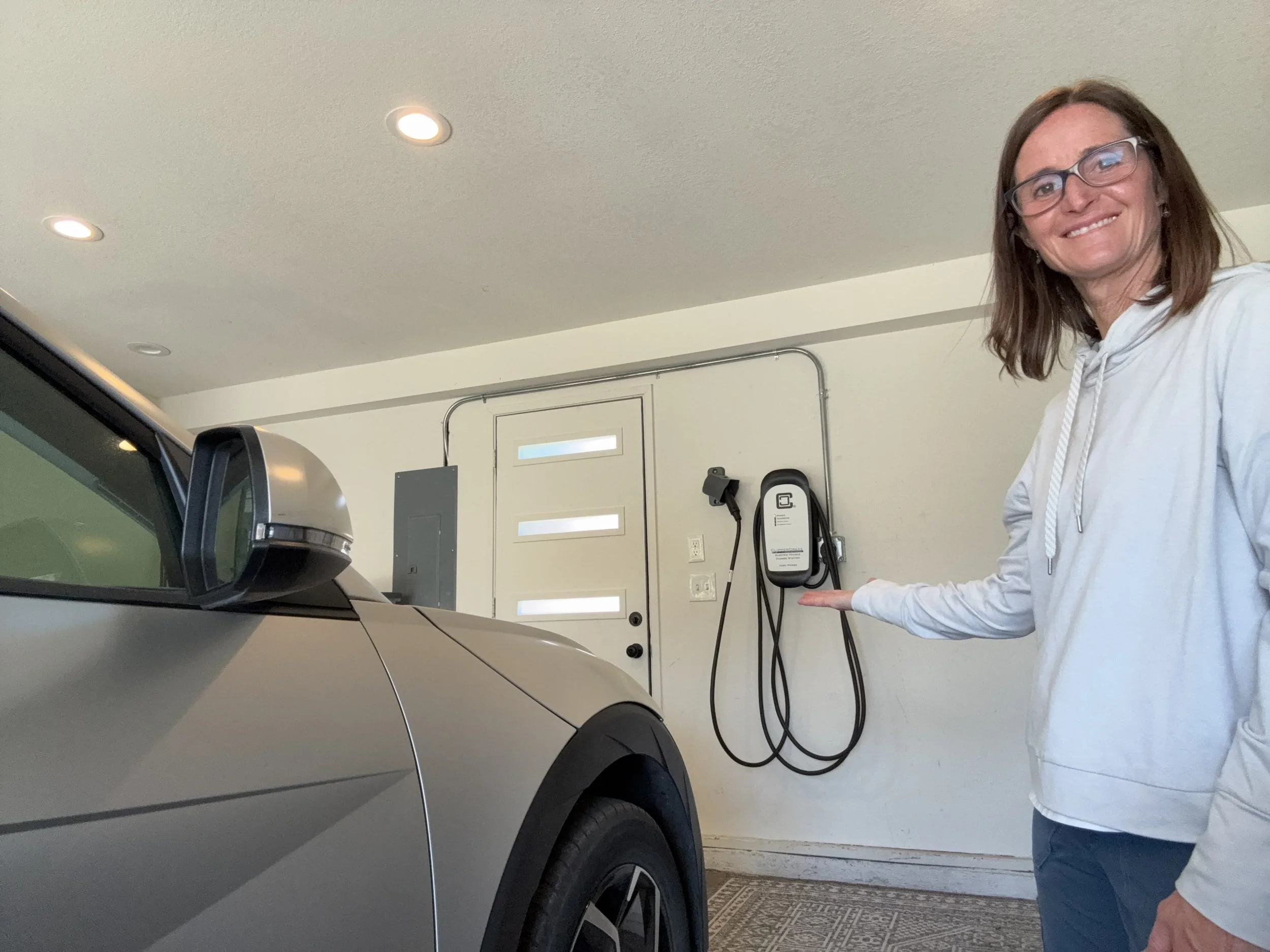
Two years ago, Sharon decided that it was time to upgrade her Leaf. She decided on a Hyundai Ioniq 5, which has a range of 300 miles. The improved range — and the exploding number of fast charging ports along I-5 — now mean that she can make a trip from Ashland to the Bay Area, powered completely with electricity.
Over the past decade, the number of EV charging spots in the United States have exploded. Today, there are six times as many public charging sites as there were in 2016. Driving along I-5, you’ll pass a fast charger — which can take an EV battery from empty to 80% in less than an hour — every five miles, on average.
Charging deserts do still exist, Sharon says. An all-electric road trip from Ashland to Boise or Utah isn’t yet possible, because of a long stretch without chargers in Eastern Oregon. Even trips along highways with abundant charging opportunities do take some logistical planning. (On a trip to San Francisco, Sharon usually stops to charge twice.) But there are easy workarounds. For a recent trip to Salt Lake City, Sharon simply rented a gas-powered car on Touro, a car-rental app. The slight inconvenience was worth the money saved and ease of day-to-day life with an EV, Sharon said. And with every year, these trips become easier. It didn’t used to be possible to drive to the coast or through Northern California, for instance — these days, those trips are a piece of cake.
The economics of EVs
Car ownership is expensive — but owning an EV can make it significantly less so. Over a five year period, the average American household spends nearly $12,000 on their vehicle, including gas and maintenance, according to the U.S. Bureau of Transportation Statistics. A recent analysis from Consumer Reports found that the 5-year cost of EV ownership was about half that amount. That’s partly because at-home charging is significantly cheaper than gas — A full charge, on average, costs between $8 and $26 — and because EVs are cheaper to maintain. They don’t have oil that needs replacing, serpentine belts that can snap, or transmissions that stop working.
“It’s basically a computer sitting on top of a bunch of batteries,” Sharon says. Sharon says she spent less than $2,000 in the five years that she owned her Leaf — “and half of that was tires!”
Doing the math
In the end, Alan, from Lake Oswego Sustainability Network, believes that most people can make an EV work for them, whether that’s alongside a gas-powered car or as their only form of transportation. “There are infinite scenarios for people’s specific lifestyle,” Alan says. “It all comes down to doing the math. What I’ve seen is that people who go electric do not go back to gas.”