
When you’re on a budget, electrification can be a game changer
As cost of living spikes, Americans are struggling to pay their home energy bills. A 2024 report from the U.S. Energy Information Administration found that a third of households forego food or medicine to pay for their gas and electricity — an eight percent jump from 2020. There’s a way to cut down on these expenses by thousands of dollars each year: Electrification, the process of switching from gas appliances to ultra-efficient electric appliances.
Electrifying makes heating and cooling more accessible to families, frees up money for other necessities and can even allow people to save, says Julie Williams, Founder and Board President of Seeds for the Sol, a Willamette Valley non-profit that helps Oregonians electrify. “They have increased security, and better ability to save,” Julie said, “That relief is huge.”
But for families living month-to-month, the upfront costs of electrification can be prohibitive. That’s where Seeds for the Sol comes in. It helps households estimate the cost of electrification, apply for rebates, and even access zero-interest loans.
We spoke to Julie about how Seeds for the Sol got started, the barriers to electrification, and what happens when low-income households gain access to clean, affordable energy.

More security, greater comfort
Seeds for the Sol began with a dare. For 16 years, Julie, a retired High School Teacher, taught a course called Sustainability and Society. Each year, she encouraged her students to create a project that would have an impact on the school, larger community, or the globe. Then in 2012, her students turned the project around: “They challenged me to create my own project,” Julie said. “They wouldn’t let me off the hook.”
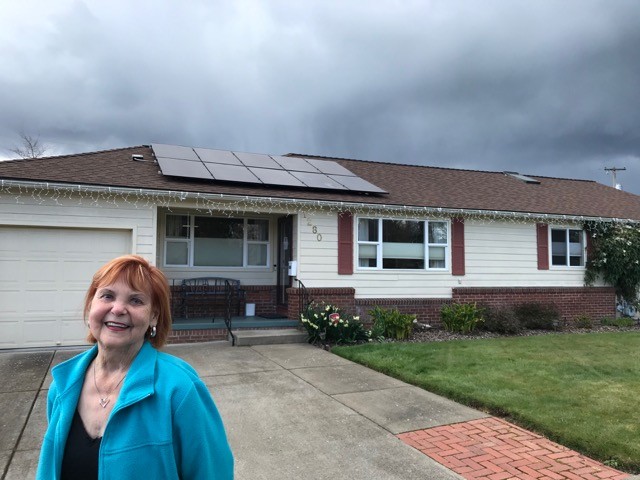
So Julie decided to install solar panels on her roof. Her intention was to benefit the climate, but she quickly saw a benefit to her wallet. “The incentives were so strong that I got all my money back fast,” she said. “After that, all I did was save.”
The experience made Julie a home energy evangelist. But even when she shared about how much she was saving, people were wary of the upfront costs of solar. Her solution was to create a zero-interest fund for community members to install solar energy and other home energy upgrades with minimal upfront costs or debt. In addition to funding the upgrades, she provided education, walking people through the electrification process and directing them to financial incentives.
Nearly fifteen years after that dare, Seeds for the Sol has supported more than 1,000 households in Lane, Linn, Benton, Polk, Lincoln and Marion counties, connecting them with incentives and loans to help pay for home-energy upgrades — or in many cases, providing those upgrades at no cost. For loans, the monthly payment is based on the household’s estimated monthly energy savings, so that their expenses remain the same or decrease.
One household that received help from Seeds for the Sol had gone without heat every single winter for years before learning about the organization through a flyer in the mail. Within months, the family had their own heat pump, a highly-efficient electric heating-and-cooling device. Another woman was able to open her own savings account for the first time in a decade, thanks to her energy savings. “People often don’t expect to save as much money as they do,” Julie said.
Another unexpected benefit of electrification is comfort, Julie says. The people that Seeds for the Sol helps report quieter homes, fresher air, and more consistently comfortable temperatures.
Get started
Seeds for the Sol’s financing options are income-dependent and available primarily to households in the middle-Willamette Valley — but the organization provides education and resources to all Oregonians. To find out more, visit their webpage or contact info@seedsforthesol.org.
Seeds for the Sol isn’t the only resource available to low- and middle-income Oregonians. For Portland residents, ElectrifyPDX has a list of Low or no cost options for home energy upgrades, including free e-bikes and weatherization, and community solar that cuts down on electricity costs.
More good news: incentives are coming that could cover between 50 to 100 percent of the cost of home energy upgrades. These programs, known as HOMES and HEAR, will be a game changer for many families. “They’re coming soon,” Julie said. “Be patient.”
Until then, Electricity Oregon provides free coaching to help connect households with available programs and incentives. Connect with us to find out how much funding you qualify for — it may be more than you realize.
© 2025 electrify oregon. All rights reserved.